The shift from being able to having to
Whereas 2025 was mainly about “getting the technology in order,” 2026 is the year in which organizations must finally convert their data-driven foundation into real value. The need for a single data platform, the rise of real-time analytics, and the growing focus on data quality are no longer emerging trends; they are now prerequisites. And the generative AI hype? It hasn’t disappeared, but it has transformed. Whereas 2025 was still largely about prototypes, talking points, and sky-high expectations, 2026 will be the year of sober reassessment—where structural commitment, integrity, and return on investment take center stage. Technology is no longer the stumbling block. The challenge lies in managing expectations, people’s ability within the organization to adopt new technologies, and the willingness to take responsibility. The question is shifting from what is possible to what is necessary.
A practical perspective
This annual trend overview is written for executives, managers, data professionals, and policymakers who are serious about data-driven working, Business Intelligence, and Artificial Intelligence. The article is based on conversations with customers, training courses, and advisory engagements conducted by Passionned Group, supplemented with recent research data. We are 100% independent of technical vendors and present our vision based on facts from everyday practice.
The predictions presented here are therefore not based on ivory tower thinking, but on insights drawn from the practical experience of organizations in the midst of their digital transformation, ranging from municipalities and healthcare institutions to commercial SME+ companies.
1. From BI and AI to a single decision-making ecosystem with a new role for the analyst
 The dividing line between Business Intelligence and Artificial Intelligence is rapidly blurring. Whereas BI traditionally focused on looking back and explaining, and AI on predicting and generating, a new domain is now emerging in which both disciplines complement each other. Think of business decisions that are augmented by AI. This does not mean that humans will disappear, but that they will be empowered.
In this new ecosystem, data is not only analyzed but also interpreted, enriched, and immediately converted into action. We have often said that the days of looking back with dashboards are over, and that BI, supported by AI, will increasingly evolve into a “decision box.” This shift is now becoming increasingly clear, for example in the way the traditional analyst is evolving into a decision architect—someone who not only produces reports, but also considers which decisions data makes possible and what the ethical and strategic implications of those decisions are. Business and IT are merging.
This creates opportunities for SMEs. Those that already have their data platform in order can now truly focus on speed and value: shorter decision cycles, real-time customer insight, and operational optimization. The technology is there. The question is: do we dare to use it to its full potential?
2. GenAI finds its place and puts traditional AI back on the map
 In 2025, generative AI was still the magic word that promised to solve everything. Entire sets of tasks could be outsourced, and LLMs were expected to make some roles redundant. In 2026, we expect a sharp correction. LLMs in particular appear to require more time for quality checks than the amount of work they actually take over from employees. Productivity and quality gains have proven to be limited, and many technical challenges can still be solved faster and more cost-efficiently with traditional AI than with custom GPTs.
In 2026, the focus will shift from output to input: generative AI will primarily be used to improve data quality. Think of automatic classification of customer information, detecting inconsistencies, or enriching metadata. Humans will remain at the helm. This is not a “sexy” application, but it is the most impactful one—because only when data is reliable can AI truly deliver value, especially in strategic applications. Many mid-sized organizations are discovering that generative AI offers the greatest value precisely here: not at the front end, but deep in the engine room of their data-driven ecosystem.
Organizations that make a difference combine predictive and generative techniques to continuously improve processes. They do not measure success by model accuracy alone, but by impact on customer satisfaction, turnaround time, or profitability. The hype is over; now it is all about sustainable impact and tangible results.
As a result, more and more companies are putting the brakes on training large foundation models that deliver little direct business value and mainly drain resources (see trend 7, the price of intelligence). The hype appears to have run its course. Instead, many organizations are rediscovering the power of classic, predictive AI and machine learning: models that are explainable, quicker to implement, easier to maintain, and better suited to changing market conditions.
Generative AI is not losing its usefulness, but its monopoly. It is returning to what it essentially is: supportive—a smart assistant that enriches data, summarizes texts, or personalizes customer interactions, but does not form the backbone of the strategy.
3. Data warehousing: reevaluating the foundation
 Data warehousing is alive and well, precisely because AI requires a robust foundation. Anyone who thinks they can successfully implement AI at scale without having the basics in place is in for a rude awakening. Without clear definitions and proper governance, models quickly descend into arbitrariness.
With the emergence of newer, more affordable, and more scalable data warehouse solutions, enormous opportunities lie ahead—particularly for SMEs. Those that have their data house in order, take governance seriously, and focus on agile decision-making can keep pace with the big players without taking on their complexity.
It is more important than ever to invest in a single, consistent data architecture—not by collecting more data, but by understanding it, structuring it, and making it reusable. By 2026, the data warehouse will no longer be a dusty archive, but the silent engine behind every intelligent application.
4. The rise of multi-agent and multimodal AI
Whereas until recently we spoke of one large language model that had to do and answer everything (think of ChatGPT), a new generation of smaller, specialized models that communicate with each other is now emerging. We refer to this as agentic AI: an architecture in which multiple AI agents work together and can independently perform tasks.
Imagine, for example, an organization preparing a monthly marketing campaign. One agent collects current sales data and customer behavior, a second analyzes the effectiveness of previous campaigns, a third generates new text and image suggestions tailored to the target audience, and a fourth automatically checks whether the communications comply with corporate identity and privacy guidelines. A fifth agent then produces a concise advisory report for the marketing manager, who makes the final decision. Instead of one “superbrain,” we are seeing a distributed ecosystem of digital assistants, each with its own role, capabilities, and responsibilities. At the same time, these systems are becoming multimodal: they understand and combine different types of information—such as text, images, audio, video, sensor data, and even contextual signals from physical environments.
 This opens up new perspectives for organizations. A few additional examples:
- A municipality could deploy multiple agents: one to scan incoming permit applications, one to interpret regulations, and one to support the human caseworker with well-founded recommendations.
- In healthcare, different agents can work together to analyze patient data, check protocols, and flag deviations, while the physician with final responsibility always makes the final decision.
- In business, agents can connect the entire chain of sales, customer contact, and administration. One agent automatically prepares a proposal based on previous deals, customer profiles, and current pricing. A second agent personalizes the accompanying email in the appropriate tone and style. Once the customer agrees to the quote, a third agent generates the invoice, verifies the details, and books it directly into the administrative system.
- For example, a manufacturing company can combine real-time video footage of machines with sensor data and maintenance logs, enabling AI not only to predict defects but also to explain why they occur.
This development makes AI more powerful, but also more complex. When decisions arise from the interaction of dozens of agents and data types, the question “why did the system do this?” becomes increasingly difficult to answer. Transparency, explainability, and security are therefore becoming central themes. The discussion is shifting from “is it possible?” to “should we allow this, and do we want this?” This will be explored further in trend 6: “privacy, ethics, and governance as growth factors.”
For leaders, this implies a new kind of responsibility: not being able to do everything, but knowing when to stop. In a world where machines are learning to operate more autonomously, human judgment, vision, and control are becoming strategic competencies. A mature organization not only sets limits on the data it collects, but also on the autonomy it grants its digital systems.
The future of AI is therefore not one big brain, but a collaborative network of agents, of departments, and of humans and machines. Those who master this dynamic will turn intelligence into a culture rather than a trick.
5. Real-time as the new normal
What was still an ambition last year has become the norm in 2026: real-time is the new standard. The days of monthly reports and rearview mirrors are behind us. Organizations that want to compete today must make decisions based on what is happening now.
Real-time analysis is no longer a technical luxury, but a strategic necessity. The speed of markets, customer behavior, and technology is forcing organizations to think and act in short cycles. This applies to virtually every sector—from retail, where inventory levels and pricing are adjusted hourly, to healthcare institutions that adapt staffing levels based on current patient data. Organizations that only act once a report has been published are simply too late.
However, this requires more than a data stream or a dashboard. Working in real time demands a fundamental shift in mindset and organization. It means that data is no longer an end product, but a continuous process. New skills play a key role here, such as continuous monitoring, data delivery as a process, and agility in decision-making.
 Thanks to modern data architectures, event streaming, and cloud infrastructures, even mid-sized organizations can now build their own “real-time nervous system.” SMEs do not have to be left behind: with a well-designed data foundation and smart automation, even smaller organizations can learn faster, decide faster, and improve faster than ever before. Contact us here to discuss the possibilities.
Successful companies understand that speed is only valuable when combined with quality and meaning. Real-time data without context leads to noise and knee-jerk decisions. That is why the focus in 2026 will shift from “how fast can we measure?” to “how smart can we respond?”. Organizations that excel know how to translate data into immediate, well-considered action. They have clear decision-making rules, governance around data access, and a culture in which people dare to act on the basis of current insights.
For leaders, this also implies a change in management. Traditional reporting structures, with quarterly meetings and departmental dashboards, are no longer sufficient. Decision-making is becoming decentralized, autonomous, and adaptive. Teams are given real-time access to relevant information and the authority to make adjustments themselves. This requires trust, transparency, and mature data literacy. It forces organizations to simplify their processes, trust their data, and give their people room to act. Not more data, not faster tools, but a smarter organization that can act when it matters. Real-time decision-making is therefore the ultimate test of maturity.
The Data Science book for Decision Makers & Data Professionals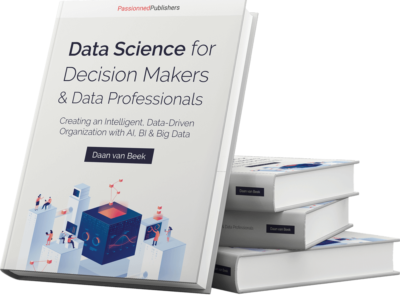 In this comprehensive Business Intelligence book, you’ll discover how to use BI and AI in a mature way — exactly the shift organizations need to make in 2026. The book covers the entire spectrum of data-driven work: from a robust data foundation and data quality to governance, ethics, real-time decision-making, and the integration of both traditional and generative AI. You’ll gain a practical framework to identify process issues early, using KPI dashboards, machine learning, GenAI, and clear decision rules. From now on, make data-driven decisions without losing your professional intuition.
6. Privacy, ethics, and governance as growth factors
 By 2026, the EU AI Act will be fully operational. In practice, however, many organizations still treat it primarily as a compliance exercise—a checklist that needs to be completed. The spirit of the legislation, which aims to promote responsible and transparent use of AI, often remains a formality, mainly for large technology companies, and according to critics lacks a broader moral perspective.
For example, there is currently no instrument that assesses the full 360-degree impact of an AI application: what this technology means for people, organizations, the environment, culture, and social relations. As long as this systemic view is missing, ethics will remain a matter of good intentions rather than structural responsibility.
At the same time, data ethics is clearly in the spotlight, and we expect this trend to continue in 2026. Public opinion is becoming more critical. A good example is the campaign by citizens in certain circles to switch from the chat provider WhatsApp to Signal, driven by concerns about the former provider’s privacy policy and transparency. It is a small example of a movement that is becoming increasingly vocal. Organizations that are transparent about their data, can clearly explain how their models work, and are explicit about where they draw the line, earn the trust of both customers and employees.
“If ethics becomes a strategic foundation, is that a sign of genuine awareness of its importance—or are we witnessing the rise of a new form of ethics washing, the moral cousin of greenwashing in the sustainability world?”
The ethics of AI remain elusive. Models learn from data, and data reflect the world as it is, including our prejudices, inequalities, and blind spots. As a result, discrimination and profiling are, in a sense, embedded in the DNA of AI. This is not malicious intent, but a mirror of our collective history. It is therefore an illusion to think that we can make AI completely ethical. The question is not whether bias exists, but how we deal with it: how we build mechanisms to recognize, correct, and compensate for it.
This is precisely the core of mature governance. Rather than correcting mistakes after the fact, it is about responsible design from the outset. Governance ensures clear ownership, verifiable decision-making rules, and transparent documentation. In organizations that get this right, model cards, ethical impact assessments, and audit trails are as commonplace as financial reports—not to slow innovation, but to ensure that it remains sustainable and explainable.
For organizations, this means that governance must mature: not as a bureaucratic safety net, but as an integral part of strategy and a catalyst for trust. A mature data-driven organization does not see governance as a brake, but as a growth accelerator. It understands that trust is the new currency—internally among employees and externally with customers who must remain willing to share their data.
The question is no longer how we can use data, but how we can do so responsibly.
7. The price of intelligence
 AI is not free—not financially, not environmentally, and not socially. Stanford’s AI Index shows that the costs of model inference and energy consumption are rising sharply. As a result, the sustainability agenda is directly influencing data strategy.
With the rapid growth of AI applications—such as large language models, image recognition, and data analysis—enormous amounts of additional computing power and storage capacity are required. That capacity comes from data centers, a significant share of which are located in Northern Europe. According to a recent McKinsey study, demand for data center capacity is expected to triple over the next five years, and it remains uncertain whether this demand can be met.
“But even if all currently known plans are delivered on time, there could still be a data center supply deficit of more than 15 GW in the United States alone by 2030.”
(15 GW is roughly equivalent to four times the annual energy consumption of Denmark, or enough to power 37 million households for an entire year.)
In the coming years, it will therefore become increasingly important for organizations to assess the cost-to-serve of their algorithms and the environmental impact of their data centers. We believe it is important to be able to experiment with new technologies. However, generating AI videos during your lunch break or choosing generative AI over traditional machine learning purely because of the “newness factor” will (have to) come with an expiration date.
Using prompts, caching, and smaller models more intelligently can not only reduce costs but also help prevent reputational damage. Sustainability is becoming an integral part of mature data policy.
8. From hype to integration – a human perspective
 The core idea is simple, yet often underestimated in practice: a tool is only as strong as the employees who use it. At the same time, this is also where the greatest challenge lies, according to CEOs of several large Dutch companies, as noted in a recent article in Het Financieel Dagblad.
Where data analysts once created dashboards and managers received reports, employees are now increasingly expected to interpret insights themselves, make data-driven decisions, and take action. Without sufficient guidance, time, and thoughtful design, this can lead to stress, resistance, or indifference. In a previous blog, we noted that a gap between technology and people is emerging in many organizations, with significant consequences for employee engagement, motivation, and sense of purpose.
A mature organization therefore treats training, coaching, feedback loops, and a culture in which employees have a voice in what data and models mean for their work as essential elements of its strategy. Technology then becomes an extension of human capability, not a replacement or a bystander.
In 2026, we expect—or hope—that more organizations will stop adopting technology simply because it is “innovative” and instead focus on technology that is actually used, adds value, and is embedded in the culture. As we have said before, fewer dashboards with higher daily usage are the golden key. Put people first and focus on adoption.
Ultimately, organizations that integrate technology in a people-centered way not only become more effective, but also more enjoyable places to work.
9. The time for pipe dreams is over
 The question has been in the air for some time: when will the AI bubble burst? Investment in artificial intelligence is unprecedented. According to the Stanford AI Index Report 2025, more than $120 billion in venture capital flowed into the sector during the first three quarters of 2025, more than half of it into generative AI. Yet revenues are lagging behind. Even market leader OpenAI, now valued at more than $500 billion, generated “only” $4.3 billion in revenue in the first half of 2025. The gap between expectations and reality is therefore significant.
Like every technological wave, AI follows the classic pattern of inflated expectations. Gartner’s Hype Cycle has described this for decades: first the promise, then the peak, followed by disillusionment. We are seeing exactly this process unfold in the AI market. Companies, governments, and investors have poured billions into language models, cloud infrastructure, and semiconductors at record speed, while the actual economic value remains limited.
We are already seeing venture capital begin to recognize this. We do not expect the funding tap to be turned off in 2026, but it is likely that the flow will slow somewhat. As a result, part of the market will run aground—particularly smaller AI startups, often without sustainable revenue models, that will disappear or be acquired.
Still, a market correction is not necessarily a disaster. When the excess air leaves the market, what remains is what truly adds value: AI that improves processes, helps customers, and supports employees. The rest will fade away, as with any technological hype. The history of the dot-com crash shows that such a correction can pave the way for maturity. That said, we must accept that a share of AI companies will not make it to the finish line.
A complete market collapse seems unlikely, as AI is increasingly becoming infrastructure—much like electricity or the internet—deeply embedded in the economy. The value is simply shifting from model builders and a sea of self-proclaimed AI experts to organizations that apply (traditional) AI in a meaningful way. A necessary realism is entering the market. The time for castles in the air is over. What matters is not who has the largest model, but who is smartest at translating it into real, measurable value.
In conclusion: from technology to maturity
The future of BI and AI is not a battle between humans and machines, but a pursuit of collaboration. From technology to meaning. From hype to value. From experimentation to maturity.
We predict that by 2026, the focus will shift from tools and pilots to adoption, human leadership, and responsible use. The organizations that truly make a difference are not those that have invested the most in technology, but those that understand that data, AI, and human insight together form an ecosystem. Within that ecosystem, the emphasis is no longer on reporting or predicting, but on meaningful decision-making—fast, transparent, and responsible.