Learn how to make timely adjustments with Performance Management
Performance management makes performance transparent and helps you improve it with dashboards. But what exactly is performance management and what does it involve? To manage your performance well, you take a number of logical steps, but when developing a performance management system, you can also easily get stuck, sometimes resulting in considerable resistance. Besides many advantages, performance management also has its objections and risks. Simply dismissing objections is obviously not the solution. Everyone needs to understand that performance management is not meant as a tool to settle accounts but to develop the organization. An overarching, integral model is therefore more than welcome. It allows you to discover together what the success and failure factors of your team or organization are, learn from them, and improve. The results can be discussed on a weekly or daily basis, issues can be solved, and the insights gained can be disseminated throughout the organization.
What is Performance Management?
In practice, the concept of performance management is not always well understood. The fact that there are many different definitions of performance management in circulation does not really help for a good understanding. Passionned Group’s consultancy practice therefore uses a clear and unambiguous definition from which many organizations have already benefited. Our definition of performance management is as follows:
Performance Management is the deliberate, data-driven measurement, monitoring, and continuous improvement of the performance of organizations, teams, and individual employees using performance indicators.
Please note that performance management is not optional. It is an intensive and continuous improvement process, including feedback procedures and analysis, that follows a set pattern, in which you have to actually start involving everyone in the organization and making data-driven decisions.
Why should you do Performance Management?
With performance management, the management of your organization becomes more balanced. You will no longer steer on financial figures alone. After all, they only say something about your performance afterward: the rear-view mirror. With performance management, you look at an integral system of interrelated goals, critical success factors, and KPIs. That gives you many more opportunities to predict, continuously improve, and more effectively monitor and execute your organizational strategy. You get more visibility and, above all, a better grip on your business model.
The 11 advantages of Performance Management
- You instantly see how your company, department, or team is performing
- There is a focus on the goals that really matter, which are 100% aligned
- The organization or team functions more effectively and is more agile
- Employees better understand the drivers of financial results
- Teams focus more on these driving forces and work closer together
- Your organization has a stronger control of the critical success factors
- People no longer work side by side as they once did.
- Employees understand what truly matters, including their behavior
- The quality of products and services improves almost automatically
- Profitability increases dramatically, and there is less waste
- Customer and employee satisfaction ultimately increase dramatically
Our Integrated Performance Management model
Our approach involves more than just looking at indicators. Our integral model (see Figure 1) provides you with a framework within which performance management can be truly successful.
- Formulate a clear mission and goals. Organizations that have a clear mission and goals generally perform better. Therefore, try to describe your organization’s right to exist as sharply as possible in one sentence or a few words. The more compact the better: “To organize the world’s information and make it accessible and usable for everyone” (Google).
- Draw a strategy map. On a strategy map, draw the cause-and-effect relationships between the critical success factors. Critical success factors are factors that are decisive in whether or not pre-set goals are achieved. For example, without a dedicated sales director, you’re going to miss important market and buying signals, causing potential sales to be lost.
- Track the right KPIs. Key Performance Indicators are the key to improving your organization’s results. Keep the number as small as possible. KPIs should get to the heart of your organization and its processes. The ideal number of KPIs depends on the size and complexity of the organization and the number of strategic goals you formulate. Our KPI Guide can help you with that.
- Make use of interactive dashboards. Dashboards are the heart of the Integral Performance Management Model. They are a visual representation of the key information necessary to achieve one or more goals. Therefore, let the results capture the imagination using one or a few clear dashboards. Learn how to build effective dashboards.
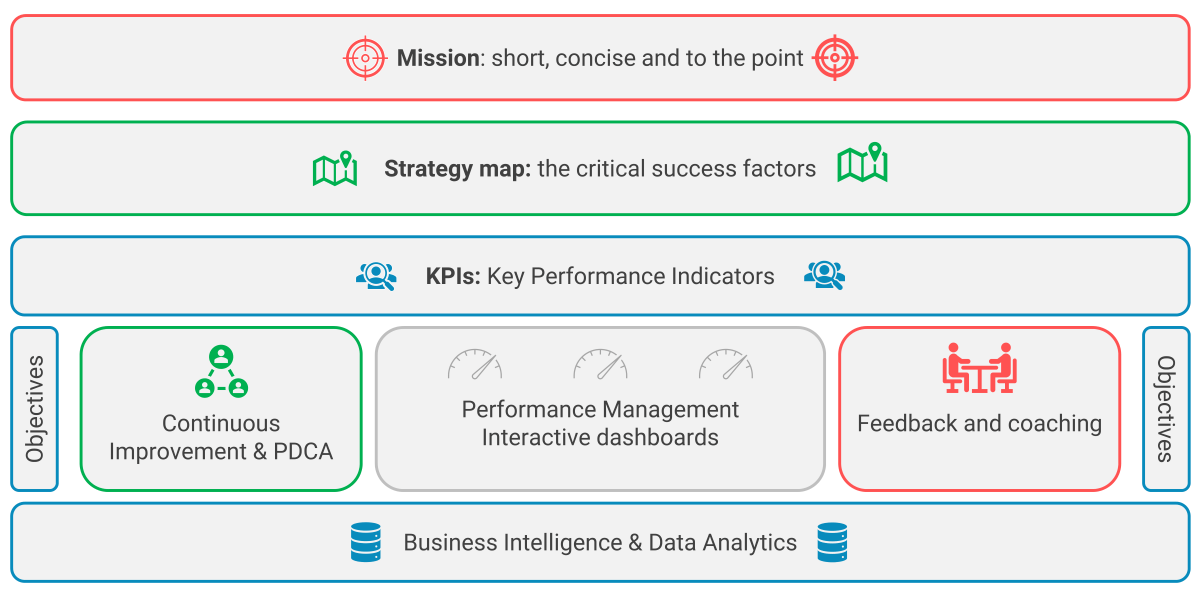 Figure 1: The performance management framework touches the mission, strategy, KPIs, continuous improvement, process optimization, feedback, and Business Intelligence. If you take away one component performance management will not be functioning properly.
- Establish a process of continuous improvement. Measuring the performance of the organization, teams, or employees once or periodically, say once a year, does not make much sense. Continuous improvement using the PDCA cycle is the only way to keep the Integral Performance Management model alive and to keep people alert.
- Exploit the potential of feedback and coaching. Addressing each other on negative as well as positive results is certainly not yet common practice in many organizations. It doesn’t fit our culture very well. We prefer to keep it cozy in the boardroom and on the shop floor. And we are not too generous with compliments. That’s a shame because feedback & coaching are indispensable for a healthy performance culture.
- Invest in Business Intelligence and Data Analytics. The benefits of BI and data analytics are comprehensive. Better decisions, less searching, and less miscommunication lie ahead. New, enlightening insights and surprising patterns are the icing on the cake. However, the road to a well-functioning Business Intelligence system is long. For example, you can distinguish as many as 101 steps.
What are critical success factors in Performance Management?
With performance management, you start by clearly identifying the key performance indicators within your organization. After all, each department is responsible for several key pieces of the puzzle. With KPIs, you discover the common thread: the critical success factors of your strategy. It is important to determine exactly what these look like. What and how do marketing, sales, production, IT, human resources, and procurement ultimately contribute to higher customer satisfaction, better financial results, and the overall performance of your organization? That insight can be gained through a so-called strategy map.
With real KPIs, you take advantage of all opportunities
Without insight into your unadulterated KPIs, you’re probably missing out on serious opportunities. Sure, it’s great that you can see that your market share, number of quote requests, number of new clients, and your sales are growing. But do those also tell you whether you’re actually doing well for the longer term? No, because your market share may be growing, but at what cost? That’s why you also need to look at real KPIs such as your productivity, utilization, lead times, and waste. You can then immediately see that you can improve even more. This is useful, especially in times when your results seem to depend mainly on the economic situation. However, KPIs always offer you serious opportunities to further improve your performance. For better or for worse.
Roadmap: take the 4 right steps in Performance Management
The roadmap for performance management may look simple: follow the following four logical steps and the job seems done. Realize, however, that each step involves intensive consultation, mutual alignment, and balancing interests.
- Step 1: obtain clarity with each other about the goals of Performance Management.
- Step 2: determine the critical success factors and define the real KPIs.
- Step 3: find the tools to measure and show progress at each KPI level.
- Step 4: learn to manage the indicators with each other and secure improvement in the process.
If you can’t figure it out yourself, contact us and our performance specialists will be happy to help you on your way.
What are the exact goals of your organization?
Your organization probably has a mission and a strategy. But are they concrete enough? Do your people understand them and, most importantly, can they act on them? Our article (in Dutch) ‘Quality and performance from a strategic perspective‘ shows that employees understand their contribution to the strategy in only 26% of cases. With integral Performance Management, you ensure that everyone can connect to the critical success factors of your strategy. Once the starting situation is clear not only at the corporate level but also at the departmental level, you can start defining targeted goals and standards for each KPI. In this way, you will have clarity and focus on the goals that really matter, at all levels in your organization.
Managing performance
Armed with a clear starting position and clear goals, you can work with your teams to manage and measure performance. You can then begin to manage for more than just financial numbers. With specific Performance Management tools such as a Balanced Scorecard and a KPI dashboard, you can periodically and at the right frequency determine the intermediate results achieved. You get insight into whether final goals per KPI, per department, and/or per person are (going to be) achieved. And you can see where deviations are taking place and whether adjustments are necessary. It also ensures clear communication and more coherence. Especially when you embed it in a continuous improvement cycle such as the PDCA cycle.
Personal involvement increases exponentially
Through Performance Management, you also increase the personal involvement of your employees and managers in the performance of your company. It makes employees aware that financial results are the outcome of interrelated processes and factors. So not only hard work but also well-thought-out marketing concepts, customer knowledge and awareness, logistical innovations, and human capital are going to help you improve your business model.
3 surprising perspectives on Performance Management
Given the ever-increasing popularity of management models, more and more organizations are embracing Performance Management. Often from the perspective of planning and control, continuous improvement, or strategic management. But there are also a number of other interesting angles with surprising results, cutting both ways.
1. Develop your organization with Performance Management
 Recent research shows that you should not use Performance Management purely for monitoring performance. Chances are, performance improvement will not happen. So how should it be done?
- Excellent system for organizational development. In fact, Performance Management systems also turn out to be excellent systems to use in organizational (re)development and managing strategy. Not every system, but those that consistently link the higher-level scorecards to those directly below them. This is done by consistently asking the question, “How are we going to achieve that?” and “What is critical to that?” for each level objective formulated.
- An organizational structure automatically emerges. And then don’t forget to answer that question again with clear, quantified objectives. These objectives are then assigned responsibility to the appropriate group(s) or persons in the organization. From this, an organizational structure automatically emerges: “Who does what?” or even stronger: “Who is responsible for what?” In this way, ownership – a key success factor in Performance Management processes – can be established very naturally.
- Quick insight into those activities that do not add value. As a derivative of this process, it also becomes clear which of the implemented activities in the organization do not add value to the realization of an objective. This “waste” should at least lead to discussion about the usefulness of the activity.
2. Improve your quality with Performance Management
 Many quality management systems still exist today, which are activity-oriented: manuals full of procedures describing how to work.
- Integral implementation makes manuals obsolete. Integral implementation of Performance Management makes those manuals redundant. The focus is no longer on the activity, but on the results to be achieved with it.
- A small step towards completely procedure-free ISO 9001. And because a good balanced scorecard also uses the right measurement and reporting frequencies, i.e.: tailored to the risk of the process, process management and control of the sub-processes is taken care of in one effort. And then the step to a completely procedure-free ISO 9001 management system is only a small one.
- Performance management is a godsend for INK model users. Performance management is also a godsend for organizations working with the INK model. The various result areas are already quantified with performance indicators. Again, the step to also manage the management focus areas based on the results to be achieved with those processes is very effective.
3. Make Performance Management work positively for your staff
 On the personnel front, a good Performance Management system and SMART goal setting have a number of positive effects. Meet the 4 most important effects here.
- Space is created for open discussions. The first positive effect is that a balanced scorecard is an excellent communication tool. Not only do your employees at all levels become familiar with your organization’s direction, but there are more effects. If you formulate goals, you must also test them for realism. Unrealistic goals should be avoided. Moreover, certain preconditions always apply. Then discussion soon ensues about the level of ambition of the objective. But discussion also follows with the first higher level about the set objective.Typical comments during this process:
- “then I must have this or that in time from that colleague”
- “for that I need so much time and money”
- “for that I need my people to undergo professional training”
- Contribution to goals is formalized. The second effect is that through Performance Management, employees can indicate what the organization can expect of them. This gives the organization insight into the level of ambition of the objectives and allows it to make statements about them. At the very least, you should reach an agreement on objectives between the two hierarchical levels involved. This agreement has the character of a performance contract: parties get clarity on mutual expectations.
- A more equitable system of evaluation emerges. The third effect is that if these agreements are clear, the assessment of someone’s performance can also be determined objectively along these lines. So you can provide a fair(er) appraisal system.
- Job classification becomes redundant. Finally, the fourth effect is related to the previous one: job classifications based on knowledge, activities, and responsibilities become ‘superfluous’. In the new situation, you will define the function on the basis of the results to be achieved and the best way to achieve them.
In short: if you see Performance Management primarily as a system that you have to implement, you are definitely selling yourself short. Also remember our mantra: for every euro you invest in technology, you should also invest one in people.
The 4 objections to Performance Management
Introducing a Performance Management system in practice often comes with objections:
- Resistance to change and formalization. The introduction of Performance Management evokes resistance because it reduces the existing non-commitment. This comment is correct: the non-committal is indeed reduced, but this is actually seen as desirable in the context of the methodology. Managers cannot engage exclusively in flashy activities; they must govern everyday practice.
- Performance management is (too) instrumental. Indeed, Performance Management relies on an instrumental approach; however, it is embedded in the management style. Periodically tracking performance with numbers is certainly part of it. But it is no good if this meets with resistance. The ownership principle must therefore be taken seriously. Nor is it good if Performance Management would lead to a complicated information structure. Instead, the starting point is that a simple but consistent information structure can ensure that managers no longer drown in numbers. Many other approaches to Performance Management fail precisely because people want to measure “everything.
- The organization is already working with performance indicators. People are not waiting for a new or more formal approach to Performance Management. Of course, if the other approach works, there is no reason to switch. If the approach does not work, however, switching becomes more interesting. But you can’t introduce the Performance Management method halfway. Management must realize up front that Performance Management requires discipline and that all steps must be taken consistently.
- Discussing “the numbers” is going to take a lot of time. After all, the state of the indicators does not indicate what actions should be taken. Other indicators provide few short-term leads for direction or change, for example, because of dependence on environmental factors that are difficult to influence. Such objections are correct but can be raised against any indicator system. That said, a group that regularly discusses indicator states is meaningfully engaged and willing to be more proactive.
We certainly do not want to downplay these or other objections. Those who find the objections valid are advised to compare the existing situation without performance management with the situation in which performance management does function. Even the latter situation will never be completely satisfactory.
Talk to a Performance Management specialist
Do you have issues with Performance Management?
Performance Management is a field with many pitfalls. The impact on your finances, processes, and people can be enormous, both positive and negative. Feel free to contact us for an appointment to discuss the issues you have with performance management. Together we will take the first step towards improving your performance in all kinds of areas.
About Passionned Group
 Passionned Group is a leading specialist in designing and implementing performance management systems & KPI dashboards. Our passionate consultants help larger and smaller organizations become smart & performance-driven.
Frequently Asked Questions
What is Performance Management?
Performance Management is a system for data-driven measurement, monitoring, and continuous improvement of the performance of organizations, teams, and individual employees using performance indicators.
What is the purpose of Performance Management?
The goal of Performance Management is to create a continuous improvement culture through which teams and employees are driven to achieve agreed organizational goals in the most effective and efficient manner.
What is a Performance Management Cycle (PMC)?
The Performance Management Cycle is a structured process focused on employee development. The main goal of the Performance Management Cycle is to get employees to set goals and improve performance annually.
How does the PMC differ from the PDCA cycle?
The Performance Management Cycle (PMC) has traditionally focused primarily on the annual assessment and performance reviews between a manager and their employees. The PDCA cycle in its primal form is an improvement method for teams, through which you initiate a continuous learning and improvement process by giving KPIs, data analysis, and human reflection a leading role.
Why should you do Performance Management?
With Performance Management, you bring more balance to your organization. You no longer steer on financial figures alone. With performance management, you will look ahead, adjust, and continuously improve. You will learn how to use dashboards and algorithms to better predict organizational performance.
Why is Performance Management so important?
Applying Performance Management gives employees and managers a better understanding of what is expected of them and how they can contribute to organizational goals.
What are the logical steps in Performance Management?
Gain clarity with each other about the goals of performance management, determine the critical success factors and define the unadulterated KPIs, develop tools to measure and show progress at each KPI level, start steering by the indicators, and secure improvement in the process.
Why do we talk about Integral Performance Management?
Integrated Performance Management touches the mission, strategy, KPIs, continuous improvement, process optimization, feedback, Business Intelligence, and so on. If you take away one component, then performance management will not function properly. So you will have to approach all the components integrally, in interrelationship. Hence the addition “integral.”
Is PM only useful for commercial companies?
No, performance management can be applied regardless of the nature of the organization. Passionned Group’s consulting practice and executed assignments show that there is a great need for an integral model for Performance Management, especially in nonprofit and government organizations.
What is the role of feedback within Performance Management?
Positive and negative feedback allows employees to grow and develop and it ultimately leads to better financial results.
What does feedforward mean?
Feedforward literally means “forward clutch.” In feedforward, you as a manager emphasize the desired and positive behavior of employees in the future. That is, you indicate in advance what desired behavior you expect from the other person, focused on a function, task, or work situation in the (near) future. This is in contrast to a feedback system that focuses on the past.